speaking as a Jew, i’m extra-super dubious of all that stuff that talks about cartoon witches being an antisemitic stereotype. I can get where the thing with the nose is coming from, but the claims about the hats are based on flimsy claims that require a lot of mental reaching. The hats that Jews were forced to wear were not a universal thing, and I’ve yet to see any evidence that they were part of the cultural consciousness by the time the image of the pointy-hatted witch became common.
The biggest points against the hat hypothesis:
Wrong time period: witch hats as we know them seem to have only started appearing in art around the 17th-18th century; in the period when the Judenhut was well-established, witches in art just wore whatever was common for women of the region.
Wrong region: the pointed witch hat originated in English art, as far as i’ve seen. Antisemitic laws in England mandated badges, not headwear.
Wrong gender: Jewish hats were mandated for men, not women—illustrations of witches with pointed hats very rarely included male witches, until fairly recently.
Wrong shape: there are many styles of mandated Jewish hat throughout history, but few of them are even a near match for the very specific look of the Witch hat.
You know what kind of hat does closely fit?
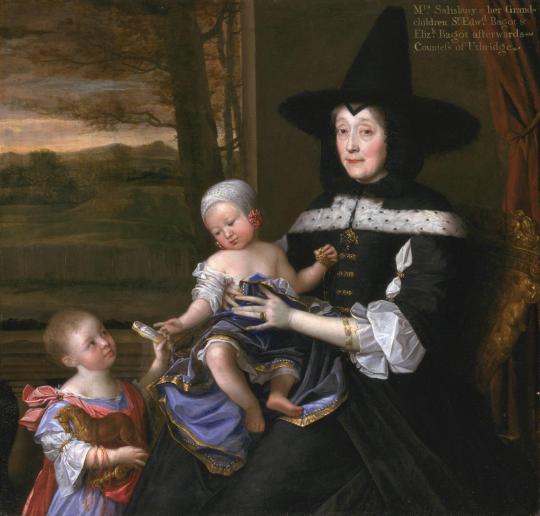
The hat in this painting (“Portrait of Mrs Salesbury with her Grandchildren Edward and Elizabeth Bagot” by J.M. Wright; circa 1675) was “a type worn by affluent women throughout Britain at this date”. Look at that hat. Any modern viewer looking at this painting might think it was supposed to be a character created by J.K. Rowling.
It’s a match in design, gender, region, and most importantly, time period: by the time that pointed witch hats started to appear in artwork in England and English colonies, this style of hat would have been associated in the cultural consciousness with elderly women, especially those who were clinging to decades-old fashions.
The easy, simple answer to where the witch hat came from: it’s exactly what a woman with all the stereotypical qualities of a witch would have worn in the first place, in the time and place the trope originated.
Old-fashioned but not by several centuries, severe and somber, and popular with a class of women that people would have spread nasty rumors about in the first place (somany accusations of witchcraft were directed specifically at women who were independently well-off, whether out of simple envy or else scheming).
Seemed like about time to bring this back up.
Another very obvious and often explicitly stated basis for the CLOTHING of the cartoon witch is Puritan costume from the 18th century… seeing as Puritans were famous for their witch trials.
The green skin, curly hair, big nose, warts etc are all definitely at least racialized things. Though big nose and warts are associated with age the combined picture is pretty much just a racial caricature.
Made this because of yet another Tumblr fiasco! Im a queer witch trying to find a new home that offers the same quirkyness as tumblr. But without the problems :)
View all posts by candlelightmagick

 Candlelight-magick