Substitutions in magick and spellwork is where you replace an ingredient for a spell with another due to lack of the listed ingredient. This is often done when a witch does not have specific plants, herbs or crystals on hand for when working a spell. This is a very common practice especially when individuals are on a budget or are still “in the forest” so unable to get specific ingredients. This is also done when a spell calls for an obscure or hard to find or even endangered herb/plant such as white sage, mugwort, nightshade, wormwood, wolfsbane and other harder to come by plants that one could not normally find in a store or local gardens.
General Substitution:
White Candles for any candle color
Rosemary for any herb/plant
Table Salt for any salt
Tap Water for any water
Clear Quartz for any crystal
Black Tea for any tea
Rose for any flower
Tobacco for any toxic herb/plant
Sage Incense for any incense
Olive Oil for any oil/carrier oil
Frankincense for any gum resin
Lemon for any citrus
Apple for any fruit
There are things in each “category” of ingredients for spells that are used for general over all substitution. Though these ingredients below can substitute for anything in their given category it does not mean that they are the best items to use for substitution in every spell. Why is that? Simply because each ingredient has different correspondences and though these items are “general” they have their own correspondences which can very much be different from what the spell is corresponding to.
An Example: Rosemary corresponds with protection, love, lust, mental powers, exorcism, purification, healing, sleep, youth. If you are using it in a spell for money it may not work as well as it would to substitute the missing herb with another herb that corresponds with money, wealth and prosperity. This is why the list above is simply for if you are in a pinch and you have absolutely nothing else to substitute in for it.
This is why it is better to go with intent based substitutions, for they tend to correspond better with the spell and are more likely to be successful. It is very easy to figure out other ingredients that work with a spell by seeing if the ingredient corresponds with the intent, such as does this crystal correspond with love in anyway? If so it is a good substitute for a love spell, if it doesn’t then it is a poor choice. This part is where you need to research yourself to ensure you are substituting things properly. Research the correspondences of what you have and see if they match with the spell you wish to find a substitute for.
Reworking
Reworking is the process of changing the actions, procedures and steps of a spell to cater to either one’s own situation or to work with ingredients that have been substituted or are missing. Reworking works hand and hand with substitution. The reason this is, is because sometimes when we substitute ingredients we can no longer use the same processes done in the spell. This is common when we substitute something such as a water safe crystal with a non-water safe crystal for a potion or substituting an edible plant with a toxic one in an edible spell.
Here is an example scenario that will show us both the process of standard substitution and reworking.
A Spell for Protection requires you to have a bowl of water and some aloe. The process of the spell is soaking the aloe in the water for a short time then rubbing the herb on your wrists and forehead. You wish to do this spell but you have come across the problem of having no aloe. Below are some examples of how to substitute with this spell and how to rework it when necessary.
Solution Example: You happen to have mint which also corresponds with protection. Mint is a non-toxic plant and it is good for your skin as well as smells quite nicely. So you easily replace the aloe leaves with mint leaves instead and go about the spell as the steps instructs. This is an example of substitution that does not require any sort of reworking.
Solution Example: You have blueberries which correspond with protection that you can use though you would rather not rub blueberries onto your skin leaving a sticky stained mess. This is where reworking is required. Blueberries are edible so instead you soak the blueberries in the water and instead eat the blueberries and then use the water to anoint yourself.
Solution Example: You have wolfsbane but it’s highly toxic and should definitely not be soaked in water, rubbed on your skin or ingested. This is a prime example of absolutely having to rework the spell for safety reasons. In this case it would perhaps be best to have the wolfsbane in a bowl and use its energy to mentally anoint yourself. This requires most likely reworking most if not all of the spell.
Reworking actions in witchcraft without substituting ingredients. This is most common due to a person’s situation or location making certain spells difficult to do. A very common example of this type of reworking would be reworking a spell to not have a burning process due to the witch being unable to use fire or burn objects due to their situation such as apartment or dorm living, lung sensitivity to smoke or having their own doubts about being able to work safely with fire due to one reason or another. Below are some suggested reworking actions for common things that some people are unable to do for one reason or another.
Substitutes for Burning: tearing/shredding, soaking in water (if safe), burying (if safe), pouring ink onto, scribbling out, erasing, crumpling or crushing, painting over, pouring wax over, cutting up via scissors, taping up
Substitutes for Ingestion: water soaking, meditation with item nearby, energy work via harnessing the item’s energy, burning (if safe), touch/holding (if safe)
Substitutes for Speaking/Chanting: thought/mental chanting, written word, gesture/sign language, listening to music with lyrics that correspond with spell/intent, air writing with finger
Reworking for Spoonies
Often spells can be too draining for those with “limited spoons” to use. In these cases, reworking a spell may often become necessary to make it easier on the witch casting it. In cases of this, certain gestures or steps may be too draining or difficult for the witch to perform due to physical or mental health. First off, this is nothing to be ashamed of, it’s okay if some things make you too uncomfortable or are just too difficult for you to do. There’s no reason to feel like you can’t do spellwork because of it. You can still do the spell by reworking the areas that you have difficulty in.
An example of this could be that a spell requires a lot of movement, gestures and chanting to do. As someone with limited energy you may not be able to exhaust so much of it by moving around like that. Instead you could examine the spell and see why that part may be required, if it is a spell to bring energy or motivation it may be added as a step to help encourage and invigorate the caster but making it difficult for you. Instead you can in this case find something that you find gives you a bit of a “pep in your step” that won’t exhaust you as much. An example may be music, listening to exhilarating and upbeat music can get the energy flowing instead so removing the chanting and dancing with loud energy filled music playing as you cast the spell is an excellent solution.
Another example may be that a witch has some lung and breathing difficulties making it very difficult for them to burn things or use incense due to it affecting their airways. In this case, the witch can examine what the spell is having them burn such as a spell for money having them burn basil and chamomile. Instead this witch can choose to soak the herbs into water or place them in a bowl near an open window to let the breeze spread their energy. Or even simply turning the spell into a sachet or jar spell instead of a burning one.
Personalization of Spells
To personalize a spell is to put your own personal touch onto it. This may include adding an additional step, adding ingredients or substituting ingredients not out of necessity but out of personal preference.
Examples of personalizing spells:
Adding the extra ingredient of rice to a money spell because you see rice as very closely related to money in your own personal practice
Adding a chant to a silent spell because you prefer chanting to get into the “witchy spirit” of the spell
Changing the spell’s written language because it is not your native one/you prefer using a different language for witchcraft
Changing the sigil in the spell to one of your personal sigils that you have a better association to the intent with
Replacing clear quartz with citrine for an energy spell because you prefer the energy of citrine over clear quartz
There are many ways to customize and personalize a spell to make it so it works better for you on a personal level. It is something that you will find easier to do with time once you have discovered the ingredients and methods of witchcraft that you prefer doing.
*note: reworking/personalizing a spell does not make it fully yours. If you wish to post this reworked/personalized spell please link it to the original or source the original seeing it was someone else’s work that you modified here and there for your own needs. It’s just polite to credit people for their work.
it’s almost june and my heart is ready to be crushed again, bring me the trembling nighthawks and the moths at the windows, and the street after dark awash in a supernal glow, tend the roses with storms and send the early morning hush of mist deep into the trees
🌹 Step 1: Infuse moon water with rose petals in a mason jar.
🌹 Step 2: Add your sexiest pair of undies to the mason jar.
🌹 Step 3: Add pink Himalayan salt and some menstral blood. Let the jar sit for at least 3 weeks on your pastel altar.
🌹 Step 4: Make your crush consume at least three drops of this potion. You’ll be married within 3 weeks and they will love you forever.
🌷🌷🌷🌷🌷🌷🌷🌷🌷🌷🌷🌷🌷🌷🌷🌷
Apparently this is a satire blog, but I did not realize that among first glance and many other witches won’t either, so I will say this. DONT DO THIS SPELL. Not only does this take consent away from someone, but it is also a BIOHAZARD. Please don’t perform this spell, thanks.
I get it, focusing on nothing or on your breath for 20 minutes every day doesn’t seem that appealing. Whether you’ve tried meditation once or committed to it for a year, there will be a stage where your meditation practise becomes flat-out boring. We all know that meditation is renowned as one of the most important ways to spend your time as it has the potential to open up many profound benefits for an individual, arguably more-so than anything else you can do in your life – so of course, I want to suggest a few approaches to help you relieve your festering boredom and encourage you to continue mediating.
I used to come out of meditations feeling refreshed and awake. However, after months of meditating, it started to sap my happiness, an effect that was completely counterintuitive with what meditation was supposed to help me with. Every meditation I finished, I came out of it feeling more drained than before; it continuously failed to produce the same sense of peace I used to feel; it was an endless sensation of boredom I couldn’t overcome. Eventually this boredom created a downward spiral of doubt and negativity that couldn’t be escaped by simply focusing on the breath.
Many meditators have said that if you meditate long enough, that stage of boredom will surpass. Meditation is, after all, used to recognise that we must accept the present moment as it is. I was skeptical this ever was going to happen – I knew I had to take a different approach.
So, here are my top 4 suggested ways I found to combat meditation boredom:
1. Visualisation Meditation: Your Peaceful Place
Visualisation is a technique you can use while you meditate. Rather than focusing on the breath, you can engage in a world of pure imagination, all in your own control. This technique is much more active for the mind – it seems to boost my creativity and ease my mind so much more than a regular breath meditation. I am an artist and visualising seems to easily slip me into a familiar state of flow as if I would when I am drawing or painting. You may be aware of the flow state yourself: it is characterised as a trance-like state, where you are in complete absorption in what you are doing (often what you love to do), resulting in a loss of one’s sense of space and time, also known as being entirely immersed in the present moment. This meditative state is what we seek during meditation: it allows us to return to the source of our soul, or subconscious, just as a breath meditation would do.
My favourite way to visualise is to imagine the most peaceful place you can picture in your mind’s eye and try to imagine yourself exploring it in vivid detail. Personally, I like to play rain forest sounds aloud on my phone while I meditate and envision myself there using all five of my senses; hearing the birds chirping; feeling the moss in between my toes sinking in the ground; smelling the earthy humidity in the air; making out shapes and colours of the space around me in progressive detail as I peek here and there.
Over time, my personal space has grown in complexity: I have a small clearing where I go to connect back with my source. I have created a hot spring there with a waterfall, a small hut with pillows to get comfy in, a yoga mat to do yoga, an area for arts and crafts – I even imagine my favourite foods, or imaginary fruits that don’t exist to explore my sense of taste and smell. I bring what I love to life in this sacred space created in my mind and I encourage you to explore your own space with freedom and joy during your mediation, especially if you usually struggle to keep the mind focused on mundane tasks such as breathing.
If you are finding it hard to visualise, there are many guided meditations that describe a peaceful place for you, which is a good way to hone your skills in visualisation. Once you are a skilled visualiser, I strongly advise you to try this technique without guidance and find joy in creating exactly what you want to create to be the next focus of your meditation, have fun with it and explore! You start waking up wanting to meditate and wondering what wonderful sensation you can conjure up next – you truly start to surprise yourself.
2. Other Visualisations: Spirit Guides, Past Life Regression, etc…
There are many videos you can find, particularly on YouTube, that claim to help you perform a past life regression or assist you with meeting your spirit guide for example. These videos all come under the same umbrella: they are all guided visualisation meditations and all are technically classified as hypnosis, as you are allowing someone else to guide your subconscious. Hypnosis allows for a certain degree of control, as it is your mind that is imagining, not the hypnotists’. Self-hypnosis, on the other hand, allows for full control. Arguably, hypnosis and self-hypnosis both seem to induce the mediative state that is accessible using breath meditation. Although both methods allow for this state, I feel it is more effective when you perform the visualisation on yourself once you’ve become skilled at it because the sensations or descriptions that come up in your meditation session will seem a lot more personal to your own subconscious and hence bring you a greater sense of peace and connection.
I often like to branch off into other ways of using visualisation once I’ve first arrived at my peaceful place during meditation. Other methods of visualising include past life regression which can help you learn more about the situations you faced in your past life memories and you can use for guidance by comparing it to you present life’s journey to help find the best solution. You can also do inner child work, where you visualise yourself comforting a younger version of yourself and bring up past memories to relive, in order to help shed yourself of the ego’s defence mechanisms, built up to defend subconscious emotional inner child wounds.
Meeting your spirit guide is also a very useful visualisation, as you can ask your guide to come forward for comfort or advice when you find yourself to be troubled at any point in your daily life outside of meditation. I also enjoy meeting my spirit guide regularly to just chill together while I am in my mind’s peaceful place. Some say spirit guides are the mind’s visual representation of your intuition and others may tell you they are genuinely real spirits. Either way, experiment with the concept of having a spirit guide and see intuitively what works for you best.
(Art by Janie Olsen)
Many people put off these techniques because they believe it is all just imaginary, they see hypnosis or self-hypnosis as mutually exclusive to the meditative state or believe it can’t actually help as effectively as meditation where you focus purely on the breath. In my opinion, visualisation is just imagination, but people often underestimate the power imagination has – it is literally our ability to tap into the vast imagery hidden deep in the subconscious, timidly waiting to be experienced. Hypnosis or self-hypnosis are often portrayed in a bad light as well – they are seen as something completely separate to experiencing a mediative state. Contemporarily, there is not enough research to distinguish whether they are practically the same thing or not, but I believe they all come under the same umbrella. My advice would be to take what I say about the effectiveness of these techniques with a grain of salt and try to experiment with it yourself – all I know for certain is that it has had a very profound effect on my life, just as much as breath meditation used to have on me and perhaps even more so!
3. Open-eye Meditation
There are many ways to meditate through out your day. My favourite and most flexible technique I have learnt is to focus on the space between objects as you do you daily routine and to be aware of not only the space in front of you, but also the space behind you. By shifting your awareness to inhabit that space, you are moving out into something much bigger than the limits of your ego mind. The more you move your awareness outward and into the universe, the more you spend time noticing the subtle beauty in everything you see, unlocking your potential to be fully present and at your highest spiritual potential.
In the book, “The Open-Focus Brain” the authors engaged in conducting experiments on volunteers to test what relaxation method was most effective at producing the most phase-synchronous alpha and measured this by monitoring their EEG. Alpha waves are one type of brain wave that predominantly originate from the occipital lobe during wakeful relaxation with closed eyes. Some were asked to visualise a peaceful scene, look at colours, try different fragrances, etc. But none seemed to produce more than a mild alpha-enhancing effect.
As soon as they asked, “Can you visualise the space between your eyes?” A high amplitude of alpha was produced immediately. The same significant increase in alpha brain synchrony was monitored after asking similar “space”-related questions which described “objectless imagery” like “Can you imagine the space between you ears?” and so on. One Eastern mystic wrote that it was important to “attain a state of mind in which even though you are surrounded by crowds of people, it is as if you were alone in a field extending for tens of thousands of miles.” The Japanese have even coined a philosophy called ‘Ma’, which is the ability to see the space between objects as well as the objects themselves. Surprisingly, it’s one of the least known techniques, yet appears to be one of the most beneficial – more research is needed!
Shifting your awareness to the space between objects is one open-eye technique and very efficient for helping you with mindfulness. You can also eat mindfully, by first appreciating where the food came from, how it has been developed over time and what others had to go through to bring it to your plate, etc, before you start eating. Appreciate the smell, the detail on the food and the colour which will help immerse yourself in the present moment. Take smaller, slower bites where you actually take the time to appreciate the texture in your mouth and the taste. Practise mindfulness like this with all the sensations of all your five senses throughout your day, not just at meal time, and you will find your sensory world will strikingly come to life. If you have a constant awareness of your own thoughts and feelings developed through being present and mindful, you can easily decipher and notice which thinking patterns serve you and which ones need replacing.
4. Yoga
Yoga, Tai Chi or any exercise that operates through sequences of bodily movements that are interwoven in coordination with the patterns of the breath are forms of meditation. Yoga is mostly seen as a physical exercise across the Western world but in Indian traditions it is considered much more than physical exercise; it has a meditative and spiritual core. It can also make your meditation practise much easier if you do it directly after a physical practise, as it imposes your awareness to shift into the sensations felt in your muscles and breath rather than the ego mind, creating a much more comfortable starting point to meditate.
Incorporating all four or even a few of these different types of meditation into your day-to-day routine may be enough to completely replace breath meditation if you loathe it that badly. Personally, when I started using all four techniques, it made breath meditation a more approachable and a lot less of a boring practise for me and I began to find it as peaceful as I did back then once more!
Confused or have desperate questions about this blog post? Feel free to send a message and I will be happy to give advice or clarification as soon as possible.
Something I’ve been wanting to say that I’ve noticed on here and in a lot of FB groups with beginner workers and brujas:
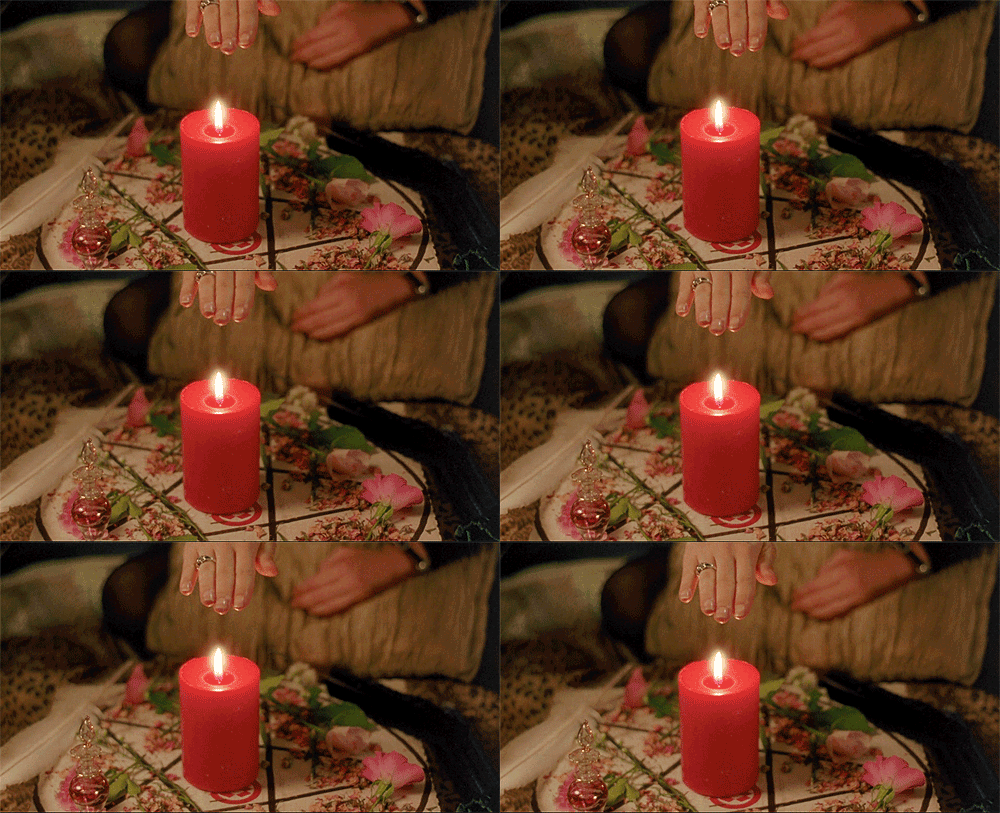
Not every result in your candle spells are going to be magical please keep this in mind
The plate you burned a candle on broke? Maybe it’s a sign. Or maybe the plate couldn’t handle the direct heat and just broke. Make sure you use heat safe surfaces.
The glass of your 7 day candle cracked? Could be a sign. But it could also just be that you had it on for too long and a number on other factors. Don’t leave it on for so long at a time.
Your candle refuses to light? Could be a sign. Or maybe you just drowned your candle with too many oils and herbs and it’s snuffing out the flame. Don’t drown it next time to avoid it.
Soot all over the glass? Could definitely be a sign! But it could definitely also he the herbs you used causing the smoke as well. Try not to be too heavy on the herbs to avoid this.
It’s never that simple. Don’t negate common sense for the sake of making everything magical. Acknowledge the spiritual meaning but also realize this is real life and there could very much be scientific reasons for something happening in your candle work too. Not everything is easily explained but not everything is magical either. It’s important to have a healthy balance of both.




 Candlelight-magick