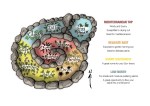
The garden spiral is like a snail shell, with stone spiraling upward to create multiple micro-climates and a cornucopia of flavors on a small footprint. Spirals can come in any size to fit any space, from an urban courtyard to an entire yard. You don’t even need a patch of ground, as they can be built on top of patios, pavement, and rooftops. You can spiral over an old stump or on top of poor soil. By building up vertically, you create more growing space, make watering easy, and lessen the need to bend over while harvesting. To boot, spirals add instant architecture and year-round beauty to your landscape: the perfect garden focal point.
One of the beauties of an herb spiral is that you are creating multiple microclimates in a small space. The combination of stones, shape, and vertical structure offers a variety of planting niches for a diversity of plants. The stones also serve as a thermal mass, minimizing temperature swings and extending the growing seasons. Whatever you grow in your spiral, it will pump out a great harvest for the small space it occupies. I’ve grown monstrous cucumbers in my large garden spiral, with one plant producing over 30 prize-size fruits. The spiral is a food-producing superstar!
Stacked stones create perennial habitat for beneficial critters, such as lizards and spiders that help balance pest populations in the garden. The stone network is a year-round safe haven for beneficial insects and other crawlies that work constantly to keep your garden in balance—and you in the hammock. A little design for them up-front pays big, tasty dividends later.
Tag: herbs
Study tips for herbalists
A lot of people ask me about how to start learning about herbs and which courses are good, so I decided to put this together for you guys!
Resources
- Herbmentor.com
- Here are a few useful herbs that are good to start out with
- Check out my recommended books
- Paul Bergner has excellent information and courses available here
- The East West School of Planetary Herbology is a great place to take courses
- The Lunar Apothecary is a great for leaning about herb magic and lunar herbology
- This website will help you to find local plants (USA only)
- Bear Medicine Herbals
- Herbcraft.org
- Herbal Remedies Advice
Tips
- Check out local plant societies to see what activities they have planned. Some of them offer free plant walks that will help you to get to know your local plants
- Start experimenting with your (safe) local weeds first. For many of you, this means sorrel, dandelion, plantain, violet leaf, and ground ivy.
- Get your warnings and safety information from reputable books and herbalists, not social media (tumblr). There are many rumors on this site about what is and isn’t poisonous, please don’t believe everything you read!
- Keep a few materia medica books on hand to check for contraindications and safety instead. My go-to books for checking whether an herb is okay with me are located in the recommended books post above
- Pick 1 herb a month to really focus on. Keep in mind that you can do a lot with a few herbs, some of them have dozens of uses
- Learn about your herbs by tasting and using them, not just reading! Personal experience is more important than book knowledge (except when it comes to safety)
Equipment
- JARS (check the thrift store for cheap finds)
- Alcohol – I usually use 80 proof vodka for tinctures but you can also use brandy depending on what you’re making
- Oils- I like grapeseed oil and coconut oil
- Funnels
- Cheese cloth for straining herbs
- Kitchen scale
- French press (easy way to make loose leaf tea)
Idea of what to start making with herbs
- Bruise/injury salves
- Bug sprays
- Calming tinctures/teas
- Digestive tinctures/teas
- Pain tinctures
- Fomentations
- Poultices
I probably forgot a lot of stuff so Ill be adding more in the future!
Herbs Associated With The Dead
Here’s a quick post of herbs used to summon, talk to, or celebrate with the dead. It was created to invoke ancestors specifically, but I hope this helps all of you guys!
Bay leaves promote communication with the dead, are used in funeral wreaths, and shared during ancestral feasts on Samhain.
Birch is associated with rebirth and reincarnation. Blessings for the deceased are written on birch bark and burned.
Cedar is used to summon the dead, and in ancestral feasts.
Elderberries are used to decorate altars during Samhain.
Frankincense is used for purification while communicating with the dead and spiritual transformation.
Holly is associated with resurrection and renewal, thus making it an appropriate decoration for Samhain altars as well.
Lavender is used to bring peace to the dead.
Rosemary is burned in Samhain ancestral feasts to communicate with deceased friends.
Rose represents love, healing, and purification, also making it a great Samhain altar decoration.
Tobacco is used as an offering during ancestral feasts.
Wormwood is used to summon spirits and help them manifest.
Sources:
“Wortcunning: Herbs of the Deceased.” Nafaeria. n.p. 7 August 2008. Web. 17 October 2015.“Necromatic Herbs: Plants of the Dead.” WordPress. n.p. 8 December 2013. Web. 17 October 2015.
Happy ritual making, and happy Samhain!
Quick Guide to Lotions and Potions
Infusion
Infusions work best for making tea from leaves and flowers as these plant parts give up their active constituents easily.
Allow the tea to steep for 10 to 20 minutes so the therapeutic properties can pass from the herb into the water.
To make an infused oil put dried herbs in the top of a double-boiler, cover with oil about an inch over the herb (olive works well for this because it has a fairly long shelf life), let simmer for 2 hours without letting it get too hot or boiling, a temp of 150 F is good. Strain the oil into a clean jar, date and label. Without any preservatives, infused oil will last about a year.
Decoction
Teas made from roots and twigs are most often brewed by decoction because it is more difficult to extract their medicinal properties any other way. Boil or simmer 1 to 2 teaspoons of the herb per cup of water for 10 to 20 minutes.
Poultice
A poultice is a paste of chopped, fresh (or dried and then re-moistened) plant material which is applied directly to a wound or skin infection. It is held in place by a wet dressing covered by a bandage. Poultices are most often used to prevent infection and hasten healing.
To make a poultice, boil, steam, or pound the healing herb of your choice to release more medicinal compounds. Then shape the material into a small, coin-size wad which can then lie flat against the wound. Many herbalists recommend mixing 1 part herb with 3 parts
water, alcohol, witch hazel or vinegar. Thicken with flour to make the poultice easier to handle and apply.Note: doing a patch test first would be a very good idea to make sure your skin doesn’t get irritated.
Tincture
Stuff dried herbs into a jar, add enough alcohol (usually vodka or everclear (natural grain alcohol), depending on the strength needed for the particular herb) to amply cover the herbs, and screw the lid on. Allow the mixture to stand for about a week, shaking it occasionally. Then strain it, discard the plant material, and store the tincture in a bottle with a dropper lid. Label and date the bottle. Most tinctures have a shelf life of 2 years.
Wash
A tea or infusion meant only for external use. A mild form of a wash would be ¼ ounce of herb to one pint of boiling water, steeped until lukewarm, then applied.
Herbs Good For Luck
- Allspice: Incense made of allspice herb are used to promote luck, health, and happiness
- Chamomile: It is the gambler’s lucky herb. Not long ago, gamblers were known to bathe their hands in chamomile solutions for better luck at gaming (they may be still doing it)
- Frankincense: The Magi presented this aromatic herb to the savior. Carrying a small piece is considered lucky
- Nutmeg: Long considered a charm for good luck, nutmegs are work as lockets and bracelets. They are often strung along with star anise.
- Sandalwood: Burnt as incense, and used in soaps and talcum powder, sandalwood is a sign of luck and prosperity.

